Needles and Ambition: The Forgotten Women Who Ran Jersey City's Garment Factories and Stitched a Nation's Wardrobe
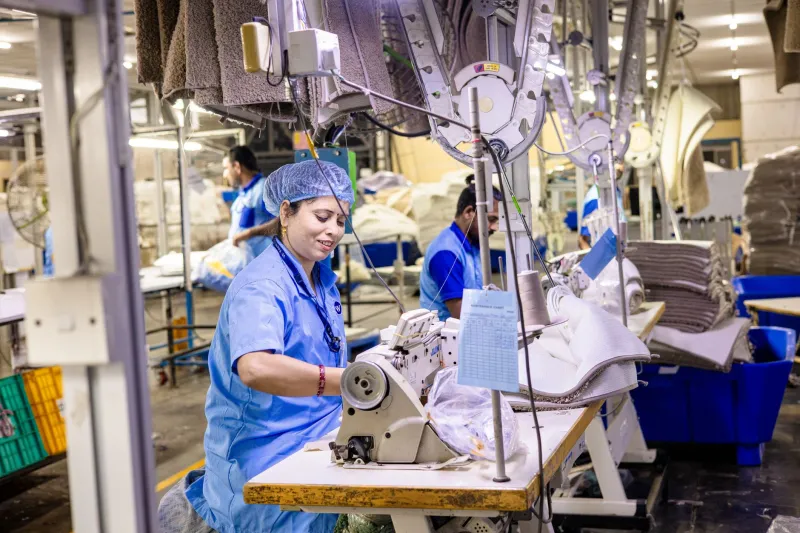
In the early decades of the twentieth century, a visitor walking through Jersey City's densely packed manufacturing corridors — particularly along the blocks radiating outward from Journal Square and the older commercial arteries near the Hudson waterfront — would have heard, above the ambient roar of streetcars and delivery wagons, a persistent mechanical rhythm: the rapid, insistent percussion of sewing machines running from before dawn until well past dusk. That sound was the heartbeat of an industry that has since vanished almost entirely from public memory. Jersey City was, for several decades, a significant node in the American garment trade, and the hands that kept those machines running belonged overwhelmingly to women.
Their story is not a simple one. It involves ambition and exploitation in nearly equal measure, labor solidarity forged across language barriers, and a form of civic contribution that was never adequately acknowledged during these women's lifetimes and has rarely been acknowledged since.
A Geography of Cloth and Labor
By approximately 1905, Hudson County had established itself as a credible satellite of the broader New York metropolitan garment industry. Manufacturers seeking relief from Manhattan's escalating rents and increasingly organized labor pools found Jersey City an attractive alternative. Rail connections made the shipment of finished goods straightforward, and the city's already established immigrant communities — Polish, Italian, Jewish, and later Puerto Rican — offered a dense reservoir of workers accustomed to piecework and capable of rapid skill acquisition.
The factories themselves ranged considerably in scale and condition. Some occupied purpose-built loft structures along Newark Avenue and the streets immediately surrounding it, buildings that still stand today though their original functions are entirely unrecognizable. Others operated out of converted rowhouses and tenement upper floors, the informal sweatshop arrangements that labor inspectors repeatedly cited in their annual reports to the New Jersey Department of Labor. Hudson County inspection records from 1911 through the mid-1920s document dozens of such establishments, noting overcrowding, inadequate ventilation, and fire exits blocked by bundled fabric — conditions that mirrored, on a smaller scale, the catastrophic failures that had made the Triangle Shirtwaist fire of 1911 a national scandal.
The Women Behind the Machines
The workforce was not monolithic. First-generation Italian immigrants, many of them young women who had arrived with needle skills developed in the agricultural south of their home country, formed the backbone of several of the larger establishments. Jewish women from Eastern Europe — particularly from the Pale of Settlement regions of Poland and Russia — brought with them not only sewing expertise but also exposure to labor organizing traditions that would prove consequential. Polish Catholic women, concentrated in neighborhoods near the older industrial parishes, made up a third significant cohort.
What united them across these ethnic divisions was the structure of their working lives. Piecework was the dominant compensation model, meaning that income was directly tied to output rather than to hours worked. This arrangement placed the entire burden of productivity onto individual workers, who often brought additional fabric home in the evenings to extend their earning potential. The domestic space and the industrial space were never fully separate for these women; the kitchen table served as a secondary workstation, and children old enough to thread a needle were frequently enlisted.
Oral histories collected by the Hudson County Historical Society in the 1970s and 1980s, before the last generation of direct witnesses had passed, offer fragmentary but vivid glimpses into this world. One woman, identified in the archive only by her initials and her neighborhood of residence in the Bergen-Lafayette section, described beginning work in a shirtwaist factory at the age of fourteen and continuing, with interruptions for childbearing, until the factory closed during the Depression. Her account of walking to work before sunrise, of supervisors who monitored bathroom breaks with a pocket watch, and of the fierce loyalty she felt toward coworkers who shared her native language, captures something that labor statistics alone cannot convey.
Organizing Across the Language Divide
The International Ladies' Garment Workers' Union, which had been a force in Manhattan's garment industry since the early 1900s, extended its organizing efforts into Hudson County with mixed results. Language fragmentation posed a genuine obstacle. A shop floor might contain women who spoke Italian, Yiddish, Polish, and English, with minimal overlap between groups. Union organizers who worked the Jersey City shops during the 1910s and 1920s recalled, in their own later memoirs, the necessity of conducting the same meeting in three languages on the same evening.
Despite these difficulties, there were moments of notable solidarity. A 1919 work stoppage at a large shirtwaist manufacturer on Newark Avenue, documented in contemporaneous issues of the Jersey Journal, involved workers from at least four distinct ethnic communities acting in coordinated fashion. The strike lasted eleven days and resulted in modest wage concessions. It was not a transformative victory, but it demonstrated that the divisions manufacturers relied upon to suppress collective action were not absolute.
What the Fashion Industry Forgot
The garment district that Jersey City once supported did not collapse suddenly. It eroded across several decades, accelerated by the broader deindustrialization that reshaped the entire northeastern United States after World War II. Manufacturers followed cheaper labor first to the American South and eventually offshore. The loft buildings were repurposed, demolished, or left to deteriorate. The women who had worked in them aged, retired, and died, their occupational histories rarely recorded in any systematic fashion.
Mainstream accounts of American fashion history have tended to focus on designers, retailers, and the glamorous consumption of clothing rather than its production. When production is discussed, the narrative gravitates toward the well-documented Manhattan factories. Jersey City's contribution — significant in volume if not in prestige — has been almost entirely omitted.
This omission is not merely a matter of incomplete historical record-keeping. It reflects a broader pattern of undervaluing labor that was feminized, immigrant, and working-class. The women who stitched shirtwaists and blouses in Jersey City's factories were performing skilled work under difficult conditions in service of an industry that generated substantial profit. That their names do not appear in fashion histories, and that their city's role in the trade goes unacknowledged, is a form of erasure that responsible historical inquiry has an obligation to address.
Recovering What Remains
For researchers and community members interested in pursuing this history further, several archival pathways remain accessible. The New Jersey State Archives hold labor inspection reports that name specific establishments and, in some cases, their owners. The Jersey City Free Public Library's New Jersey Room contains runs of local newspapers that reported on strikes, factory accidents, and labor disputes. The records of several Catholic parishes that served immigrant congregations in the relevant neighborhoods — some of which have been digitized in recent years — occasionally document the occupations of parishioners in sacramental registers.
Perhaps most urgently, the descendants of women who worked in these industries may hold photographs, letters, pay stubs, or simply family stories that have not yet entered any formal archive. The window for capturing living memory, even at the remove of a second generation, is closing. Jersey City's garment history belongs not only to the academic record but to the families whose grandmothers and great-grandmothers kept those machines running — and to a city that has not yet fully reckoned with the breadth of what was built here.