Behind Locked Doors: How Jersey City's Prohibition-Era Speakeasies Became the Beating Heart of Immigrant Community Life
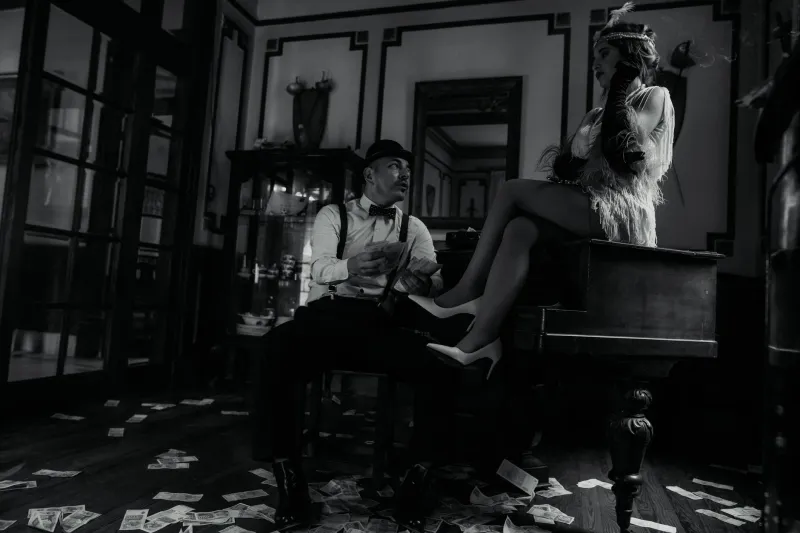
On January 17, 1920, the Eighteenth Amendment to the United States Constitution took legal effect, and the manufacture, sale, and transportation of intoxicating liquors became a federal offense. In many American cities, the saloon — long a fixture of working-class social life — was expected to simply disappear. Jersey City, a dense industrial port city whose population was composed in large measure of Irish, Italian, Polish, and Eastern European Jewish immigrants, had other ideas entirely.
Within weeks of the amendment's ratification, the city's established network of neighborhood drinking establishments had not dissolved. It had reorganized. Moved behind false walls, down basement stairwells, through unmarked rear entrances, and into the back rooms of grocery stores, barbershops, and social clubs. What emerged was not merely an underground economy but a shadow civic infrastructure — one that would prove essential to the cultural and political survival of the city's immigrant communities throughout the Prohibition era.
The Architecture of Concealment
The geography of Jersey City's speakeasy network was not random. It followed, with considerable precision, the contours of existing immigrant settlement patterns. The neighborhoods of Paulus Hook, Greenville, and the densely packed blocks surrounding the old Central Railroad terminal each developed their own distinct underground drinking cultures, shaped by the ethnic composition of their residents and the particular social pressures those communities faced.
Archival records held at the Jersey City Free Public Library's New Jersey Room reveal a pattern of raid documentation that inadvertently serves as a kind of census of the city's hidden establishments. Police blotter entries from the early 1920s describe operations discovered in converted coal cellars on Grand Street, behind sliding panels in Bergen Avenue delicatessens, and within the locked back rooms of what were nominally registered as "social and benevolent associations." The spatial clustering of these entries tells a story that no official city map of the period would acknowledge: Jersey City's speakeasies were not scattered aberrations but a coherent, interlocking system.
The physical modifications required to sustain these operations were often elaborate. Oral histories collected from descendants of speakeasy operators — several of whom spoke with local historians in the 1970s and whose recollections are preserved in the Hudson County cultural heritage archive — describe reinforced doors fitted with peepholes, drainage systems capable of rapidly disposing of evidence, and in at least two documented cases on Newark Avenue, hidden compartments designed to conceal both product and patrons during police inspections.
Frank Hague and the Politics of Selective Enforcement
No account of Jersey City's Prohibition experience can proceed far without confronting the figure of Frank Hague, the city's Democratic Party boss whose political machine dominated municipal governance from 1917 through 1947. Hague's relationship with Prohibition enforcement was, to employ a generous characterization, transactional.
Publicly, Hague maintained a posture of law-and-order rectitude. His administration conducted periodic, highly publicized raids on speakeasy operations, generating favorable newspaper coverage and satisfying federal oversight requirements. Privately, however, the machine's ward-level operatives functioned as informal licensing authorities for the underground trade, collecting what amounted to protection payments from operators who wished to remain open without serious interference.
This arrangement had consequences that extended well beyond simple corruption. The Hague machine's selective enforcement created a tiered system in which politically connected operators — many of them Irish-American entrepreneurs with existing relationships to Democratic ward organizations — enjoyed relative security, while newer immigrant communities, particularly Italian and Eastern European Jewish operators with less established political ties, faced more unpredictable exposure to genuine prosecution.
Municipal court records from Hudson County document this disparity with uncomfortable clarity. Between 1922 and 1928, the conviction rate for Prohibition violations among defendants with identifiably Italian or Eastern European surnames ran significantly higher than among Irish-American defendants facing comparable charges. The speakeasy network was not politically neutral territory; it was, from its inception, a site of contest over which communities would be permitted to sustain their social institutions and on what terms.
More Than a Drink: The Speakeasy as Community Institution
To understand why these establishments mattered so profoundly to their patrons, one must first understand what the legal saloon had represented to Jersey City's immigrant communities before Prohibition. The pre-1920 saloon was not merely a place to purchase alcohol. It was a labor exchange, a banking facility for workers without access to formal credit, a meeting hall for mutual aid societies, a staging ground for political organizing, and — for communities whose members often shared no common written language — an oral archive of cultural memory and collective grievance.
When the saloons closed, these functions did not disappear. They migrated into the speakeasy, where they persisted and, in some respects, intensified. The very illegality of the enterprise created a degree of social bonding among participants that the legal saloon had never quite achieved. Shared transgression, as historians of Prohibition have noted in other contexts, tends to produce solidarity.
Descendants of operators who ran establishments in the Lafayette neighborhood recall their grandparents describing speakeasies that hosted not only drinking but card games, informal arbitration of neighborhood disputes, early meetings of labor organizing committees, and, in one account, clandestine gatherings of Italian-language mutual aid society members who feared surveillance by federal immigration authorities. The locked door that kept out Prohibition agents also created a protected space for forms of community self-organization that the era's restrictive social climate might otherwise have suppressed.
The Women Behind the Bar
One dimension of Jersey City's speakeasy history that has received insufficient scholarly attention is the significant role played by women in operating and sustaining these establishments. In the legal saloon era, female proprietorship had been relatively rare, constrained by both licensing practices and social convention. Prohibition, paradoxically, created new openings.
Because speakeasy operations were by definition unregulated, the formal barriers that had excluded women from the licensed trade simply did not apply. Several of the establishments documented in Hudson County court records from the 1920s were operated by widows who had inherited their husbands' saloon businesses and converted them to underground operations as a matter of economic survival. Others were run by women who had never been involved in the licensed trade at all, but who recognized in the demand for illicit alcohol a business opportunity that required capital and nerve rather than a license.
These women occupy an almost entirely invisible position in the official historical record. Their names appear in court documents and, occasionally, in newspaper accounts of raids, but rarely in the civic histories and commemorative publications that shaped later understandings of the Prohibition era. Recovering their stories represents one of the more pressing tasks facing researchers engaged with this period of Jersey City's past.
What the Repeal Left Behind
When the Twenty-First Amendment repealed Prohibition in December 1933, Jersey City's underground drinking network did not simply evaporate. Many speakeasy operators applied for the newly available liquor licenses and reopened as legal establishments, carrying with them the social networks, political relationships, and community functions they had developed during thirteen years of clandestine operation.
The legacy of the speakeasy era shaped Jersey City's bar culture, its ward-level political organization, and its immigrant community institutions well into the mid-twentieth century. The social infrastructure built underground during Prohibition proved, in the end, more durable than the law that had driven it there.
For researchers and community historians, the documentary record of that infrastructure — fragmentary, dispersed across police blotters and court files and the fading memories of descendants — remains an incompletely explored archive. It preserves, in the spaces between official accounts, something essential about how Jersey City's working-class communities sustained themselves through an era that was not designed with their survival in mind.