Buried and Forgotten: What Jersey City's Neglected Cemeteries Reveal About Who Gets Remembered
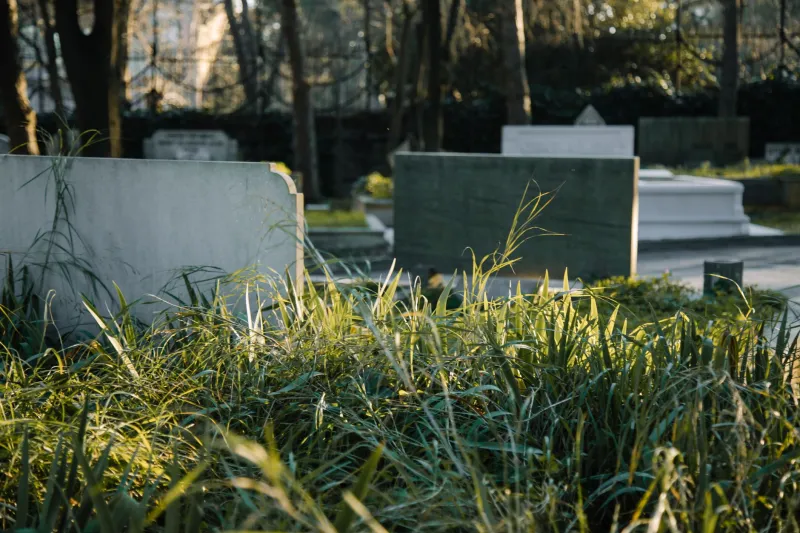
In a city perpetually engaged in the business of reinvention, the dead are rarely accorded the same urgency as the living. Jersey City's landscape is riddled with the unmarked remnants of burial grounds that once served its earliest and most vulnerable communities—spaces that have been paved over, built upon, and, in the most complete form of erasure, forgotten entirely. To study these sites is not merely an exercise in genealogical curiosity; it is a means of reading the city's moral ledger, of understanding which lives were considered worth commemorating and which were quietly surrendered to concrete and commerce.
The history of burial in Jersey City stretches back to the colonial period, when the region's Dutch and English settlers established small churchyard plots alongside their places of worship. Several of these early graveyards were associated with congregations that no longer exist, their records scattered or destroyed, their headstones long since displaced by the relentless pressure of urban expansion. Local historians and archivists have spent decades attempting to reconstruct the locations of these sites, often working from fragmentary deed records, 19th-century survey maps, and the occasional discovery of human remains during construction excavation.
The Colonial Threshold: Graveyards Before the Grid
Before the systematic street grid that now organizes much of Jersey City's older neighborhoods was imposed upon the land, burial grounds were sited according to the logic of community rather than municipal planning. Congregations buried their dead close at hand, on ground consecrated by their own religious traditions. As the city expanded and those congregations dispersed or dissolved, the cemeteries they left behind became inconveniences—land that could not easily be sold, developed, or even clearly mapped.
Several colonial-era burial sites are believed to lie beneath blocks in what is now the area surrounding the Van Vorst and Paulus Hook neighborhoods. Historical maps from the late 18th and early 19th centuries indicate the presence of small plots that were gradually absorbed into the urban fabric as Jersey City's population surged following its incorporation in 1820. Some of these sites were formally relocated—a common practice in rapidly growing American cities—while others were simply built over, their existence acknowledged only in the footnotes of property records that few people thought to consult.
Immigrant Plots and the Limits of Institutional Memory
The 19th century brought successive waves of immigration to Jersey City—Irish, German, Italian, Polish, and other communities, each of which established its own institutions, including cemeteries. Many of these burial grounds were affiliated with Catholic parishes that served specific ethnic enclaves, and their records were maintained, with varying degrees of care, by those parishes. When congregations merged, closed, or relocated, the institutional memory that had sustained the cemeteries often dissolved with them.
The consequences for the historical record have been severe. Researchers attempting to trace the burial sites of Jersey City's 19th-century immigrant communities frequently encounter gaps that cannot be filled by conventional archival methods. Parish registers were lost to fire, flood, or simple neglect. Grave markers made from less durable materials—wood, soft sandstone, or inexpensive cast iron—have long since deteriorated beyond legibility. In some cases, the only evidence that a burial ground existed at all is a passing reference in a local newspaper or a line item in a church financial record.
What survives, moreover, is not a representative sample of the city's dead. The cemeteries of wealthier communities were better maintained, their records more carefully preserved, their monuments constructed from granite and marble that could withstand a century and a half of weathering. The burial grounds of the poor—including those of Jersey City's African American community, whose history in the city predates the Civil War—were disproportionately vulnerable to the forces of neglect and development.
Race, Class, and the Geography of Remembrance
Perhaps no dimension of Jersey City's cemetery history is more revealing than the differential treatment of burial grounds according to the race and class of those interred within them. Historical research has documented the existence of burial sites associated with the city's Black community dating to the antebellum period, sites that received little institutional protection as the city grew and whose locations are now, in several cases, uncertain. The contrast with the treatment of cemeteries associated with more prosperous, predominantly white communities is difficult to attribute to anything other than the same hierarchies of value that structured Jersey City's social order during those decades.
This is not a dynamic unique to Jersey City; it is a pattern that urban historians have documented in cities across the United States. What makes Jersey City's case instructive is the degree to which the physical evidence of this hierarchy persists in the landscape, legible to those who know how to read it. A parking lot on a block where historical records indicate the presence of an 18th-century burial ground is not merely an absence; it is an argument, made in asphalt, about whose memory deserves to occupy space in the city.
The Work of Recovery
In recent years, a small but dedicated community of local historians, genealogists, and preservation advocates has undertaken the painstaking work of identifying and documenting Jersey City's forgotten burial grounds. Their methods draw on a wide range of sources: historical cartography, property title chains, ground-penetrating radar surveys, oral histories collected from longtime residents, and the institutional archives of religious organizations. The work is slow, underfunded, and frequently complicated by the reluctance of property owners to acknowledge what may lie beneath their holdings.
Cemetery restoration efforts elsewhere in the United States offer models for what this work can accomplish. In cities from Philadelphia to New Orleans, community-led initiatives have succeeded in securing legal protection for previously unrecognized burial grounds, installing interpretive markers, and establishing formal maintenance agreements. These projects demonstrate that recovery is possible—but they also illustrate how much depends on the sustained commitment of both civic institutions and the communities most directly descended from those who were buried and forgotten.
What the Silence Means
A city's relationship to its dead is, at its core, a statement about the city's relationship to its own history. The burial grounds that Jersey City has allowed to disappear were not lost through mere accident or the indifferent passage of time. They were lost through choices—choices about which properties to develop, which records to maintain, which communities to invest in and which to leave to the erosions of neglect. Those choices reflected the priorities of the people and institutions that made them, and they continue to shape what is knowable about the city's past.
To recover these spaces—even partially, even imperfectly—is to insist that the historical record be held accountable to the full breadth of the city's experience. The silent sentinels beneath Jersey City's streets cannot speak for themselves. But the archival record, read carefully and with a willingness to confront what it reveals, can speak on their behalf. That work remains unfinished, and it remains necessary.