Names in No Blueprint: Recovering the Civil Engineers Who Quietly Rewired American Urban Life
In the public imagination, cities are built by mayors, industrialists, and occasionally the architects whose names grace the cornerstones of grand buildings. What that imagination tends to omit is the quieter, more consequential class of professionals who determined whether a city could actually function—the civil engineers, municipal surveyors, and hydraulic specialists who designed the systems hidden beneath streets and behind walls. In Jersey City, that omission has been particularly severe, and the consequences for historical understanding have been significant.
The city that emerged from the mid-nineteenth century into the early twentieth was, by any technical measure, a laboratory for American urban engineering. Situated at the convergence of rail lines, waterways, and one of the most densely industrializing corridors on the Eastern Seaboard, Jersey City demanded infrastructure solutions that did not yet exist in standardized form. The professionals who devised those solutions were, in many cases, working without precedent. Their designs were improvised from first principles, tested under the pressure of rapid population growth, and refined through hard experience. That those designs then traveled—through professional journals, municipal reports, and the careers of engineers who trained under Jersey City projects—into cities across the nation is a historical fact that has received almost no sustained attention.
The Water Problem and the Men Who Solved It
Jersey City's water crisis of the mid-1800s was not merely a public health emergency, though it was certainly that. It was also an engineering problem of considerable complexity, one that required the integration of reservoir design, pipe network mathematics, and municipal governance in ways that American cities had only begun to theorize. The Passaic Valley water system, which ultimately supplied the city, required surveying work and hydraulic calculations that drew on European precedents while adapting them to the specific topography and demographic pressures of the Hudson County region.
Municipal records held at the New Jersey State Archives and fragmented collections within the Jersey City Free Public Library's New Jersey Room contain references to survey teams and engineering contractors whose full professional histories remain largely unassembled. Names appear in budget appropriations, in correspondence between city commissioners and state engineers, and occasionally in the minutes of public works committee meetings—but rarely in the kind of sustained biographical record that historians typically rely upon. Reconstructing who these individuals were, where they trained, and what subsequent influence their Jersey City work carried requires the kind of cross-referential archival labor that few researchers have yet undertaken.
What partial reconstruction reveals is suggestive. Several engineers associated with Jersey City's early water infrastructure appear in the membership rolls of the American Society of Civil Engineers, which was itself founded in New York in 1852 partly to formalize the professional identity of precisely this kind of practitioner. Their technical papers, where they survive, show a sophisticated engagement with the challenges of supplying water to a city whose population was doubling within decades—challenges that would soon confront Chicago, Cleveland, and dozens of other rapidly industrializing American cities.
Sewage, Grade, and the Geometry of Urban Health
If water supply represented one axis of Jersey City's infrastructure challenge, sewage management represented another, and in many respects a more technically demanding one. The city's terrain—partially landfilled, partially marshland, intersected by tidal inlets—made conventional gravity-based sewage design exceptionally difficult. The engineers who addressed that difficulty were navigating problems that sanitary engineering, as a formal discipline, was only beginning to articulate.
Patent records from the United States Patent Office, searchable through digitized archives, occasionally surface Jersey City-connected innovations in pipe joint design, manhole construction, and drainage gradient calculation. These documents name inventors who do not otherwise appear in local historical memory—figures whose professional contributions were absorbed into municipal practice, replicated in other cities' public works projects, and eventually standardized into engineering codes that made the original innovators invisible.
The relationship between Jersey City's grade-adjustment projects and the health outcomes of its densest neighborhoods is a dimension of this history that deserves particular attention. Street elevation work undertaken in the latter half of the nineteenth century was not merely an aesthetic or logistical exercise; it was a direct intervention in the epidemiology of a city where waterborne illness remained a chronic threat. The engineers who calculated those grade changes were, in a meaningful sense, practicing public health through geometry, and the mortality data that followed their interventions—available in Hudson County vital records—suggests that their work was consequential in ways that transcended the technical.
Bridge Engineering and the Transportation Corridor
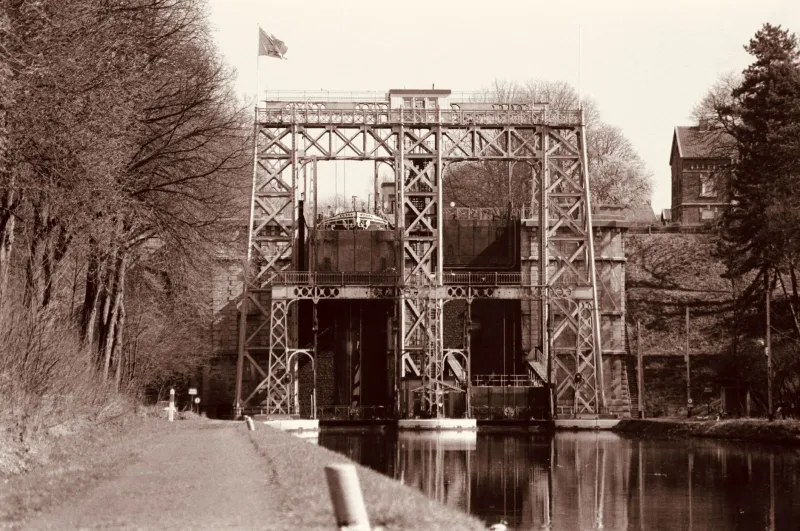
Jersey City's position as a transit nexus between the rail networks of the American interior and the port facilities of New York Harbor placed extraordinary demands on its bridge and viaduct engineers. The structures required to move freight and passengers through the city's complex topography were, in several instances, engineering achievements that attracted professional notice at the time of their construction but subsequently faded from public memory as they were replaced or absorbed into larger systems.
The swing bridges and draw spans that once accommodated both rail traffic and tidal waterway navigation represent a particularly understudied chapter in this history. Designing a structure that could bear the dynamic loads of heavy freight locomotives while remaining operable for marine passage required engineering judgment that pushed against the limits of contemporary materials science. The professionals who made those judgments—whose names appear in construction contracts, insurance assessments, and the occasional technical journal article—contributed to a body of knowledge that shaped bridge design practice across the country.
The Problem of Professional Invisibility
Understanding why these figures disappeared from public memory requires understanding how professional credit operated in nineteenth and early twentieth-century municipal engineering. Unlike private architectural commissions, which typically named their designers in legal instruments and sometimes in public dedications, public works projects were formally attributed to the municipal departments or commissions that oversaw them. The individual engineers who did the technical work were employees or contractors; the credit accrued to the institution.
This structural invisibility was compounded by the social composition of Jersey City's engineering workforce. Many of the technical professionals associated with the city's infrastructure projects were immigrants or the children of immigrants—individuals whose names, origins, and professional trajectories were not the subject of the kind of biographical attention that the city's more prominent civic figures received. Their professional identities survive, where they survive at all, in documents that were created for administrative rather than commemorative purposes.
Toward a More Complete Record
The archival work required to recover these histories is neither simple nor complete. It demands the patient cross-referencing of municipal records, professional society archives, patent databases, and the technical literature of nineteenth and early twentieth-century engineering. It requires attention to documents in multiple languages, since the engineering workforce of a city as ethnically diverse as Jersey City was not exclusively English-speaking. And it requires a willingness to treat partial, fragmentary evidence as historically meaningful even when it does not yield the complete biographical portraits that conventional historical narrative prefers.
What such work has already begun to suggest is that Jersey City's contribution to American urban development was not limited to its role as a commercial and industrial center. The city was also, in a technical sense, a proving ground—a place where the problems of modern urban infrastructure were confronted early, where solutions were devised under pressure, and where the professionals who devised them went on to carry those solutions elsewhere. Recovering their names and their work is not merely an act of local commemoration. It is a contribution to the fuller understanding of how American cities learned to function.