Ink and Industry: The Forgotten Era When Jersey City Powered America's Printing Trade
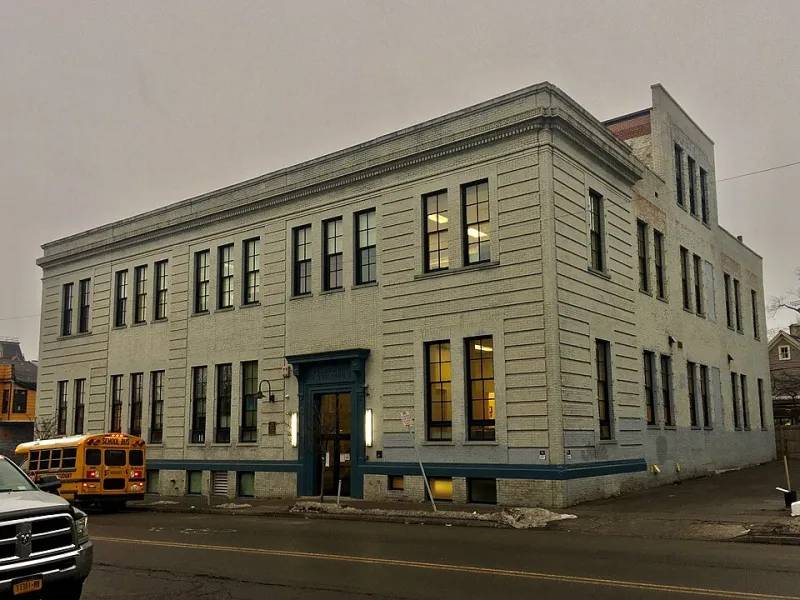
Photo: Andre Carrotflower, CC BY-SA 4.0, via Wikimedia Commons
Long before digital distribution transformed how Americans consumed the written word, Jersey City operated as a quietly indispensable engine of the national print economy, running presses that produced everything from school textbooks to mass-circulation periodicals. The industry's eventual collapse left almost no trace in public memory, erasing a complex web of immigrant labor, entrepreneurial enterprise, and industrial infrastructure that had defined entire neighborhoods for the better part of a century.
Geography as Competitive Advantage
The logic that drew printing and publishing operations to Jersey City was the same logic that had attracted railroads, petroleum refiners, and sugar processors: the city's position at the intersection of rail freight and river transport made it one of the most efficiently connected industrial sites on the eastern seaboard. For an industry whose economics depended on the rapid, high-volume movement of heavy paper stock inbound and finished printed goods outbound, this locational advantage was decisive.
By the 1880s, a cluster of printing establishments had taken root in the blocks surrounding the rail yards and freight depots that dominated the city's western and central districts. These were not small job-printing shops serving local merchants. They were industrial-scale operations equipped with the rotary presses, stereotype casting equipment, and bindery machinery that the mechanization of print had made available in the decades following the Civil War. Their customers were publishers, educational institutions, and periodical distributors located primarily in New York, but whose production economics favored manufacturing across the river where land costs, labor rates, and tax structures were more favorable.
The Infrastructure of Words
The physical infrastructure that supported Jersey City's printing industry was substantial and specialized. Large printing plants required reinforced floor systems capable of bearing the weight of heavy press machinery. They required consistent access to electricity and steam for power and for the humidity control that high-quality printing demanded. They required loading docks configured for the receipt of paper rolls arriving by rail and the dispatch of bound volumes or bundled periodicals by wagon and, later, by truck.
Several of the major printing facilities constructed in Jersey City between roughly 1885 and 1920 were purpose-built structures of considerable architectural ambition. Their facades, often executed in brick with modest Italianate or Romanesque detailing, projected an image of permanence and reliability that was commercially important — publishers and institutional clients needed assurance that their production partners were stable enterprises. Interior layouts reflected the sequential logic of the printing process, with paper storage at one end of the building, pressrooms in the central bays, and bindery and finishing operations at the shipping end.
The supply chain that fed these facilities extended throughout the region. Paper mills in northern New Jersey and upstate New York provided raw stock. Ink manufacturers, type founders, and equipment suppliers clustered nearby, creating the kind of industrial ecosystem that economists would later describe as an agglomeration economy — a self-reinforcing concentration of related enterprises that collectively reduced costs and increased efficiency for every participant.
Immigrant Hands on the Presses
The labor force that operated Jersey City's printing establishments was drawn overwhelmingly from the immigrant communities that had settled in the city's residential neighborhoods during the same decades that the industry was expanding. German immigrants, who had brought strong traditions of craft printing from Central Europe, were particularly prominent in the skilled trades — as compositors, pressmen, and bindery supervisors. Later waves of immigration brought workers from Southern and Eastern Europe into the less skilled but physically demanding roles that mechanization had created.
The relationship between the printing industry and Jersey City's immigrant communities was not simply one of employer and employee. The industry shaped neighborhood geography, with workers clustering in residential blocks within walking distance of the major plants. It supported a network of ancillary businesses — boarding houses, taverns, small groceries — that served the working population. And it created pathways for economic mobility, as skilled press operators and compositors earned wages that placed them solidly within the industrial working class and, in some cases, enabled the accumulation of modest property.
Labor organization in the printing trades was more advanced than in many comparable industries. The International Typographical Union, one of the oldest craft unions in the United States, had established a strong presence in Jersey City by the 1890s. The union's influence shaped wages, working conditions, and the apprenticeship systems through which craft knowledge was transmitted across generations. It also created tensions with plant owners who sought to introduce new machinery that reduced their dependence on skilled labor — tensions that periodically erupted in strikes and slowdowns that tested the industry's labor relations for decades.
Educational Publishing and National Reach
Among the most consequential, if least celebrated, dimensions of Jersey City's printing industry was its role in the production of educational materials. Several firms operating in the city held long-term contracts with textbook publishers whose titles were used in classrooms across the country. The volumes produced on Jersey City presses — grammar books, arithmetic texts, histories, and readers — shaped the educational experience of generations of American schoolchildren who had no awareness of where their books had been manufactured.
This segment of the industry was particularly resilient because educational publishing operated on different economic rhythms than commercial or periodical printing. Textbook adoption cycles created predictable, multi-year production runs that allowed plants to plan capacity and maintain stable labor forces. The reputational stakes were also higher — a poorly bound textbook that fell apart in a student's hands reflected badly on the publisher and, by extension, on the printer. Jersey City's educational printing firms cultivated relationships with publishers based on demonstrated quality and reliability, creating competitive barriers that protected their market position for decades.
The Long Decline and Its Consequences
The forces that dismantled Jersey City's printing industry accumulated gradually before accelerating sharply in the postwar decades. Technological change was central to the story. The introduction of phototypesetting in the 1950s and 1960s, followed by offset lithography's displacement of letterpress printing, rendered much of the existing plant and equipment in Jersey City's older facilities obsolete. The capital investment required to retool was substantial, and many plant owners — facing aging facilities, unionized workforces resistant to workforce reductions, and competition from newer facilities in lower-cost regions of the country — chose to close rather than reinvest.
The geographic logic that had originally favored Jersey City also shifted. As trucking displaced rail freight for the distribution of printed goods, proximity to rail yards became less important than access to highway networks. New printing facilities were built in suburban and exurban locations across New Jersey and beyond, drawing production away from the urban core.
The social consequences of the industry's collapse were severe and lasting. The neighborhoods that had been organized around printing employment lost their economic anchor. The craft knowledge accumulated across generations of skilled workers dispersed or became irrelevant. The physical plants, many of them structurally sound but functionally obsolete, stood vacant for years before being demolished or converted to other uses — warehousing, light manufacturing, and eventually, in some cases, residential lofts.
Recovering a Lost Legacy
The near-total erasure of Jersey City's printing industry from public memory reflects a broader pattern in which the industrial foundations of urban economies become invisible once the industries themselves have departed. The absence of a visible product — printing plants leave no smokestacks, no contaminated waterways, no dramatic ruins — makes the industry particularly difficult to recover through conventional historical methods.
Archival research offers the most reliable path back into this history. Trade publications, union records, city directories, and the corporate archives of publishing houses that contracted with Jersey City plants collectively preserve enough documentary evidence to reconstruct the industry's outlines with reasonable confidence. Oral history, where living memory still extends to the industry's final decades, provides texture and specificity that documents alone cannot supply.
Preserving this history is not merely an exercise in industrial nostalgia. The printing industry's trajectory in Jersey City — its immigrant labor force, its craft traditions, its vulnerability to technological disruption, and its ultimate displacement — anticipates patterns that have recurred in sector after sector of the American urban economy. Understanding how that cycle unfolded in one city, in one industry, contributes to a more complete and honest account of how American urban life has been built and rebuilt across successive economic eras.