Marble Stoops and Merchant Princes: The Rise and Fall of Jersey City's Gilded Age Residential Quarter
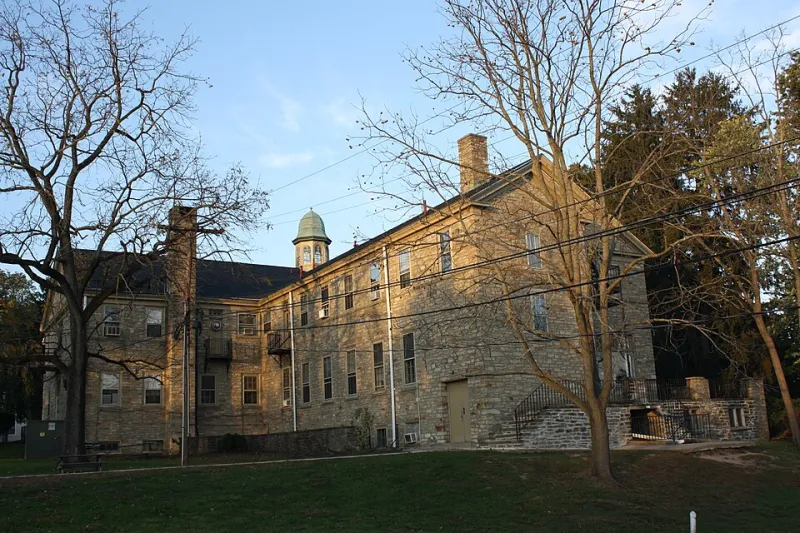
Photo: Shuvaev, CC BY-SA 3.0, via Wikimedia Commons
For a brief but luminous period in the late nineteenth and early twentieth centuries, Jersey City's elevated neighborhoods hosted an extraordinary concentration of industrial wealth, expressed in brownstone mansions and ornate row houses that rivaled the finest addresses in New York. Understanding why this elite residential culture collapsed — and what its physical remnants still communicate — offers a revealing window into how American cities have historically constructed, and then dismantled, the geography of privilege.
A City at the Apex of Commerce
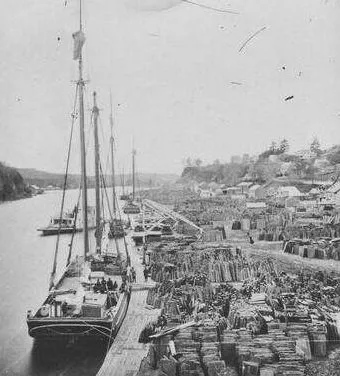
To appreciate why wealthy industrialists chose Jersey City as a residential destination, one must first understand the city's singular economic position. Situated at the terminus of nearly every major eastern railroad line, and commanding the western bank of the Hudson River opposite lower Manhattan, Jersey City was not merely adjacent to American commerce in the Gilded Age — it was, in many respects, its fulcrum. The men who controlled freight forwarding, petroleum storage, sugar refining, and the vast ferry operations that connected New Jersey to New York accumulated fortunes that demanded architectural expression.
The neighborhoods that rose to accommodate this wealth were concentrated primarily along the high ground of Bergen Hill and the streets radiating outward from what is now Journal Square. Here, removed from the industrial waterfront yet close enough to monitor its operations, merchant families commissioned architects to design residences that communicated permanence, refinement, and civic standing. The brownstone rowhouse, already fashionable in Brooklyn and Manhattan, became the dominant idiom — though Jersey City's most ambitious households favored freestanding mansions set back from the street behind iron fencing and elaborate ornamental gardens.
Architecture as Social Argument
The architecture of Jersey City's elite quarter was never merely aesthetic. Each design decision carried social weight. The Italianate brownstones that proliferated along Montgomery Street and the upper reaches of Hudson Street in the 1870s and 1880s announced their owners' familiarity with European cultural traditions. The later Queen Anne and Romanesque Revival structures that appeared in the 1890s — heavier, more assertive, bristling with turrets and terra-cotta ornament — reflected a generation of industrialists less interested in Old World refinement than in demonstrating the muscular confidence of American capital.
Several of these residences were designed by architects of genuine national reputation. The influence of firms with roots in Newark and New York was evident in the careful proportioning of facades, the quality of carved stonework, and the sophisticated handling of interior spatial sequences. Entrance halls paneled in imported mahogany, drawing rooms fitted with marble mantelpieces, and carriage houses large enough to accommodate the early automobiles that replaced horse-drawn vehicles — these were not provincial imitations of metropolitan taste but authentic expressions of it.
Urban planning historians have noted that the street layouts and lot configurations of Jersey City's elite districts anticipated suburban residential planning principles that would become standard practice after World War I. The deliberate separation of residential streets from commercial corridors, the provision of rear service lanes to render domestic labor invisible, and the careful management of street tree plantings all reflected an emerging philosophy of residential urbanism that would later migrate outward into the planned suburbs of Essex and Morris counties.
The Forces of Dissolution
The decline of Jersey City's Gilded Age residential quarter was neither sudden nor attributable to any single cause. It was, rather, the cumulative result of several converging pressures that unfolded across roughly four decades between 1910 and 1950.
The most fundamental was the democratization of transportation. As commuter rail lines extended deeper into New Jersey and, later, as automobile ownership made distance from the city center less prohibitive, the wealthy families who had anchored the established residential districts discovered that they could achieve greater spatial separation from the industrial and immigrant neighborhoods that were gradually encircling their enclaves. The suburbs of Short Hills, Maplewood, and Montclair offered something Jersey City's urban grid could never provide: insulation.
The departure of anchor households accelerated a process of subdivision that transformed the physical fabric of the neighborhood within a generation. Freestanding mansions were converted into rooming houses. Larger brownstones were divided into apartments. The carriage houses that had once sheltered horses and early automobiles became small commercial workshops or were demolished entirely to create parking. By the 1930s, the social geography of Bergen Hill and the surrounding streets had been fundamentally reorganized, and the architectural evidence of its former character was being systematically obscured or erased.
Municipal policy compounded these market pressures. Postwar urban renewal programs, which affected many American cities during the 1950s and 1960s, targeted aging residential stock in Jersey City with particular aggression. Structures that might have been candidates for preservation were classified as blighted and cleared. The institutional knowledge required to maintain ornate stonework and decorative plasterwork was disappearing from the construction trades. And the cultural consensus that would eventually produce historic preservation legislation had not yet formed.
What Survives, and What It Tells Us
The surviving fragments of Jersey City's Gilded Age residential quarter are scattered and, in many cases, compromised by later alterations. Yet they repay careful attention. Along certain blocks of Montgomery Street and in portions of the Hamilton Park neighborhood, rows of brownstones retain enough of their original character to suggest the visual coherence that once defined the district as a whole. Individual mansions — some now operating as institutional buildings, others converted to multi-family use — preserve interior details that document the ambitions of their original commissioners.
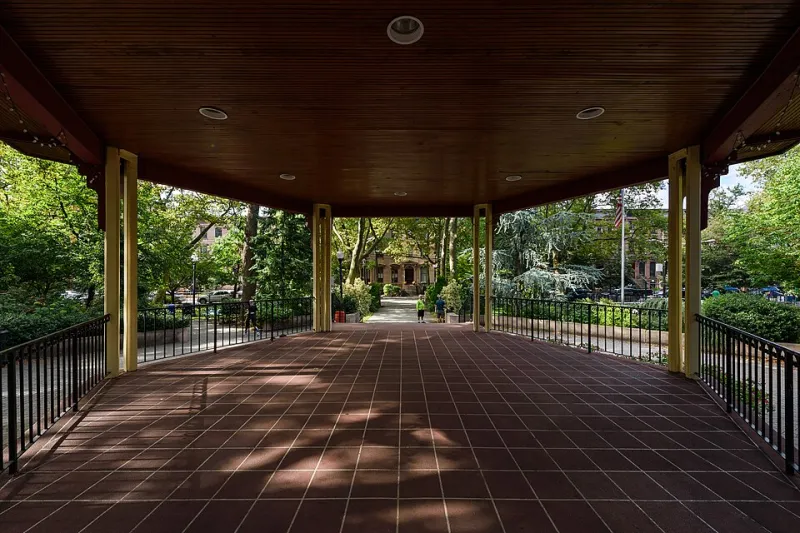
The Hamilton Park neighborhood, in particular, has benefited from sustained community investment and a degree of architectural stewardship that has kept its nineteenth-century residential fabric more legible than in other parts of the city. The park itself, a formal residential square modeled on the London precedent that influenced so much American urban design in the mid-nineteenth century, remains a spatial record of the planning ideals that shaped the district.
For historians and preservation advocates, these remnants serve a purpose beyond aesthetic appreciation. They constitute primary evidence of a moment in Jersey City's development when the city aspired to a different kind of urban identity — not merely as an industrial processing center or a gateway for immigrant labor, but as a place where American wealth chose to reside and to build. That aspiration was ultimately frustrated, and the physical record of it has been severely diminished. What remains deserves recognition not as nostalgia for a stratified social order, but as documentation of the forces — economic, demographic, and political — that have continuously reshaped the city's built environment.
Preservation as Historical Reckoning
The story of Jersey City's elite residential quarter is, at its core, a story about the instability of urban wealth and the short memory of city-building. The merchant princes who commissioned those brownstone facades assumed they were establishing a permanent social geography. Within two generations, their assumption had been proved wrong, and the city they shaped was busy erasing the evidence of their confidence.
Preserving what survives — whether through formal landmark designation, community stewardship, or the patient work of archival documentation — is not an act of deference to the powerful. It is an act of historical honesty. The Gilded Age residential quarter was built on the proceeds of industries that depended on immigrant labor, environmental exploitation, and the concentration of capital in very few hands. Its architecture reflects all of that, and its disappearance reflects the social transformations that followed. Both the construction and the demolition are part of Jersey City's story, and both deserve to be told.