Before the Stories Disappear: The Urgent Work of Capturing Jersey City's Living Memory
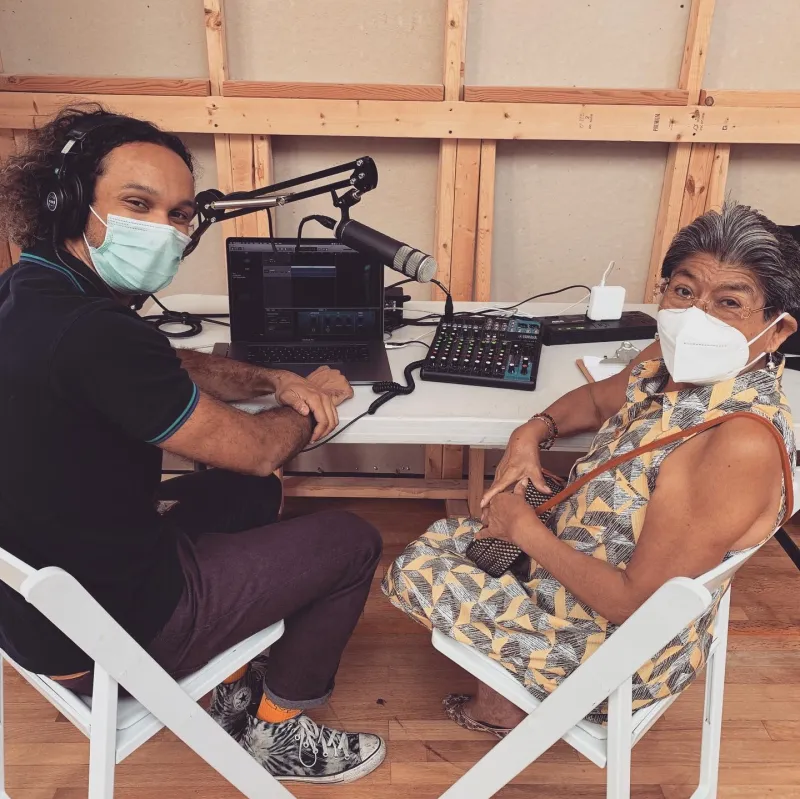
Photo: elderly resident oral history interview archive community storytelling recording, via www.qchnyc.org
In church basements, senior centers, and kitchen tables across Jersey City, archivists and community volunteers are conducting a quiet race against mortality and displacement — recording the firsthand accounts of longtime residents whose memories constitute an irreplaceable layer of the city's history. Their work raises fundamental questions about whose version of the past gets preserved, and what is lost when institutional records fail to capture the texture of everyday life.
The Gap in the Official Record
Jersey City's documented history is substantial. Municipal archives, newspaper morgues, property records, and the holdings of institutions such as the Jersey City Free Public Library's New Jersey Room contain millions of documents that trace the city's administrative and economic development across more than three centuries. What those records do not contain — and cannot contain — is the lived experience of the people who inhabited the neighborhoods, staffed the factories, worshipped in the churches, and conducted the daily transactions that gave the city its character.
That experiential layer exists only in human memory, and human memory is, by nature, finite. The residents who recall the Greenville neighborhood before urban renewal altered its geography, who remember the specific sound and smell of the Central Railroad of New Jersey terminal in its working years, who can describe the social architecture of a Marion section block in the 1950s — that population grows smaller with each passing year. When those individuals are gone, the memories go with them unless someone has made a deliberate effort to capture them.
This is the animating urgency behind Jersey City's oral history initiatives, a loosely affiliated network of community-based projects, academic partnerships, and individual efforts that have accelerated in recent years in direct response to the pace of demographic change the city has experienced.
Voices the Documents Don't Hold
The accounts that emerge from oral history work frequently complicate or enrich the picture that official records present. Consider the experience of the city's Polish community in the Greenville and Bergen-Lafayette neighborhoods, which maintained a dense institutional life — parishes, fraternal organizations, small businesses — through the mid-twentieth century. The documentary record of those institutions is fragmentary; much of it was never systematically preserved. What survives in living memory, however, is remarkably detailed.
Longtime residents interviewed as part of community history projects have described the specific geography of ethnic commercial life: which bakeries served which communities, how neighborhood boundaries were understood and negotiated, the ways in which successive waves of newcomers were received or resisted by established residents. These accounts do not simply supplement the documentary record — they provide a kind of social mapping that no municipal document could replicate.
Similar richness characterizes the memories of African American residents whose families settled in Jersey City during and after the Great Migration, establishing communities in the Greenville and Lafayette neighborhoods that developed their own institutional infrastructure, cultural traditions, and internal social hierarchies. The history of those communities as understood from within differs in important ways from how it appears in the external record, and oral history represents one of the primary means by which that internal perspective can be preserved.
The Methodology of Memory
Conducting meaningful oral history work requires more than simply recording conversations. Practitioners in Jersey City's community history efforts describe a careful process of preparation, relationship-building, and interpretive work that distinguishes serious archival practice from casual reminiscence.
Interviewers research their subjects before sitting down with them, reviewing whatever documentary context exists for the periods and places being discussed. This preparation allows them to ask informed follow-up questions and to identify moments when a narrator's account diverges from or supplements the written record — divergences that are often the most historically significant moments in an interview. The goal is not to validate memory against documents but to capture the narrator's perspective as a historical source in its own right.
The technical dimensions of the work have evolved considerably with changing technology. Early oral history projects in the region relied on reel-to-reel tape recorders and produced recordings that, in many cases, have since deteriorated. Contemporary practitioners work with digital audio and video, and a significant portion of current effort involves digitizing and cataloging older recordings before they are lost to physical degradation. The New Jersey Room at the Jersey City Free Public Library has been a central repository for some of these materials, though the broader landscape of oral history holdings across the city remains somewhat dispersed.
Displacement and the Disappearing Narrator
The urgency of oral history work in Jersey City is compounded by a factor beyond simple mortality: the displacement of longtime residents driven by the city's rapid economic transformation. Individuals and families who might once have remained in the neighborhoods where their memories were formed have, in large numbers, relocated to other parts of New Jersey or beyond as housing costs have risen. A narrator who has left the city is not lost to the historical record, but reaching them requires additional effort, and many simply fall through the gaps.
Community archivists describe a particular frustration with the pace of change relative to the resources available for documentation. A neighborhood can transform demographically within a decade, and the window for capturing the memories of those who inhabited it in an earlier era is correspondingly narrow. Funding for community history work is perennially limited, dependent on a combination of small grants, institutional support, and volunteer labor that cannot easily scale to meet the scope of what is being lost.
Why It Matters
The case for oral history preservation rests on more than sentiment. The accounts of longtime residents constitute historical evidence that shapes how future generations understand not only the past but the present — the processes of change that produced the city as it currently exists. Decisions about neighborhood development, historic preservation, and cultural recognition are all informed, at least in part, by the historical record. A record that consists only of official documents and institutional perspectives is, by definition, incomplete.
More fundamentally, the stories that Jersey City's oral history projects are working to preserve represent the city's own account of itself — a narrative assembled not from administrative records but from the accumulated experience of the people who lived it. That narrative is irreplaceable. The work of capturing it, imperfect and incomplete as any such effort must be, is among the more consequential historical projects currently underway in the city. The time available to complete it is not unlimited.