Before Ellis Island: How Jersey City Served as America's Forgotten Immigrant Threshold
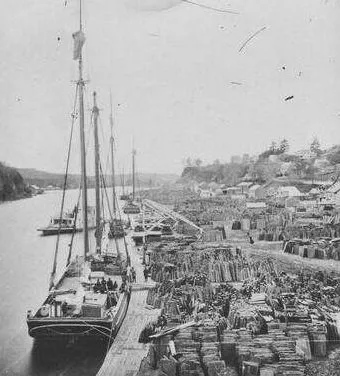
Photo: 19th century immigrant steamship dock Hudson River New Jersey historical, via www.newyorkalmanack.com
The name Ellis Island carries an almost mythological weight in American cultural memory. For millions of families, it represents the precise moment their ancestors crossed the threshold from the old world into the new. Yet for a substantial portion of the nineteenth century, that threshold was not a small island in New York Harbor at all. It was the Jersey City waterfront — a stretch of docks, rail terminals, and crowded tenement blocks that absorbed the shock of mass immigration long before federal authorities constructed their celebrated processing station.
This earlier chapter of arrival has received comparatively little scholarly attention, in part because the infrastructure that supported it was dismantled, repurposed, or simply forgotten as the city moved through successive waves of redevelopment. But the demographic fingerprints of those early decades remain embedded in Jersey City's neighborhood geography, its religious institutions, and its cultural traditions — a legacy that demands a closer examination.
The Mechanics of Arrival Before Federal Oversight
Prior to 1855, immigration to the United States was almost entirely unregulated at the federal level. Ships arriving from Liverpool, Bremen, Hamburg, and later from ports along the Mediterranean discharged their steerage passengers with minimal formality. The primary receiving points along the eastern seaboard were the commercial wharves of major port cities, and Jersey City's position directly across the Hudson from lower Manhattan made it a natural terminus for transatlantic steamship lines.
The Central Railroad of New Jersey maintained extensive pier facilities along the waterfront, and several steamship companies routed their vessels directly to Jersey City rather than to Manhattan, drawn by lower docking fees and the convenience of direct rail connections westward. This arrangement meant that an immigrant stepping off a ship in Jersey City could, in theory, board a train within hours and travel deep into the American interior without ever setting foot on Manhattan soil.
New York State's opening of Castle Garden at the southern tip of Manhattan in 1855 introduced the first organized processing infrastructure for immigrants arriving in the region, but it did not eliminate Jersey City's role. Many vessels continued to dock on the New Jersey side, and the regulatory reach of the Castle Garden facility was inconsistently applied. Jersey City's wharves remained a parallel point of entry, particularly for those traveling on rail-affiliated steamship lines.
The Boarding House Economy and Its Neighborhood Consequences
The physical needs of newly arrived immigrants — shelter, food, employment guidance, and basic orientation — generated an entire economy along Jersey City's waterfront streets. Boarding houses proliferated in the blocks immediately adjacent to the piers, many of them operated by earlier immigrants who had established themselves sufficiently to provide services to their countrymen. These establishments were frequently organized along ethnic lines, with German proprietors catering to German arrivals, Irish-run houses serving Irish immigrants, and so on.
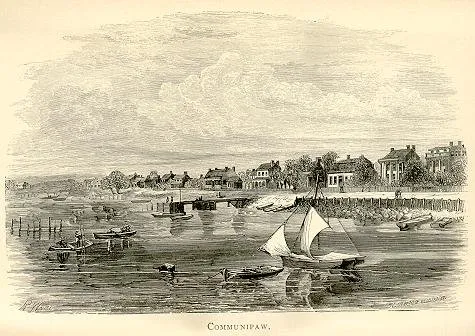
This pattern of ethnic clustering was not incidental. It reflected the practical reality that language barriers made navigating an unfamiliar city enormously difficult, and that informal networks of mutual support were often the only safety net available to new arrivals. The neighborhoods that coalesced around these boarding house clusters — areas that would eventually be known as Paulus Hook, Communipaw, and the waterfront wards nearest the rail terminals — took on distinct ethnic characters that persisted for generations.
German immigrants, who arrived in particularly large numbers following the failed revolutions of 1848, established dense residential communities in the areas north of the terminal district. They brought with them institutions — Lutheran and Catholic parishes, mutual aid societies, and eventually German-language newspapers — that gave their neighborhoods a coherent cultural identity. Irish immigrants, whose numbers swelled dramatically during and after the Great Famine years of the mid-1840s, settled in overlapping but distinct pockets, often gravitating toward the labor opportunities available in the rail yards and on the docks themselves.
Processing, Exploitation, and the Limits of Protection
The absence of robust federal oversight during this era created conditions that were routinely exploited by those who preyed on vulnerable newcomers. The so-called "runners" — agents who met ships at the dock and steered arriving immigrants toward particular boarding houses, employment brokers, or currency exchanges — were a persistent and widely documented problem. New Jersey newspapers of the 1850s and 1860s carried frequent accounts of immigrants who had been robbed, misdirected, or otherwise defrauded within hours of their arrival.
Local authorities made periodic efforts to regulate this predatory ecosystem, but enforcement was inconsistent and corruption within the dockside economy was endemic. The state of New Jersey did not establish formal immigration oversight mechanisms comparable to New York's Castle Garden until considerably later in the century, leaving arriving immigrants in Jersey City largely dependent on the informal protections offered by ethnic community networks rather than any governmental structure.
Churches played an outsized role in filling this institutional gap. Catholic parishes, in particular, organized outreach efforts aimed at meeting immigrants at the point of arrival and connecting them with legitimate housing and employment resources. Several Jersey City parishes trace their founding directly to the pastoral needs generated by immigrant communities that formed in the waterfront neighborhoods during this period.
The Transition to Federal Control and Jersey City's Shifting Role
The federal government's assumption of immigration oversight in 1891, and the subsequent opening of Ellis Island in January 1892, fundamentally altered the geography of immigrant arrival in the New York metropolitan area. The new federal station was designed to consolidate processing and impose uniform standards across all vessels arriving in the harbor, a mandate that gradually reduced the parallel role that Jersey City's docks had played for decades.
Yet Jersey City did not vanish from the immigrant experience. The rail connections that had originally made the city attractive to steamship lines now made it a transit hub through which Ellis Island arrivals passed on their way westward. The Central Railroad of New Jersey's terminal became the departure point for countless families whose first American stop had been Ellis Island but whose second was Jersey City's waterfront, however briefly.
The neighborhoods that had formed during the pre-Ellis Island decades did not dissolve. They absorbed new waves of arrivals — southern and eastern European immigrants who began arriving in large numbers in the 1880s and 1890s — and the layered demographic complexity that resulted gave Jersey City a character distinct from any other city in the region.
Recovering a Forgotten Threshold
The relative obscurity of Jersey City's pre-Ellis Island role as an immigrant gateway is partly a function of the documentary record. Federal processing stations generated systematic paperwork; the informal, semi-regulated arrivals at Jersey City's commercial docks left far thinner archival traces. Reconstructing this history requires patient work across ship manifests, local newspaper archives, church records, and the manuscript collections of ethnic mutual aid organizations.
What that work reveals, however, is a city whose identity as a place of arrival and reinvention did not begin with any single institution or federal policy. It was forged incrementally, neighborhood by neighborhood, block by block, in the decades when Jersey City stood — largely unacknowledged — as the first American ground beneath the feet of hundreds of thousands of people who would go on to shape this nation. Preserving that history is not merely an act of local pride. It is an essential correction to the broader American story of immigration.