The Road Not Taken: How Jersey City Surrendered Its Manufacturing Ambitions and Found a Different Destiny
In the decades bracketing the turn of the twentieth century, Jersey City stood at a crossroads that would define its character for generations. A combination of entrepreneurial miscalculation, political rivalry, and geographic circumstance conspired to redirect the city's industrial ambitions — and ultimately pushed it toward a future built on commerce, transit, and finance rather than the factory floor.
A Tale of Two Cities on the Rise
By the 1870s, both Jersey City and Paterson occupied enviable positions in the northeastern industrial landscape. Paterson, roughly seventeen miles to the northwest, had already earned its nickname as the "Silk City" through Alexander Hamilton's deliberate vision of a planned manufacturing metropolis anchored by the Great Falls of the Passaic River. Jersey City, meanwhile, possessed something Paterson could never replicate: direct proximity to New York Harbor and the railroads threading westward across New Jersey.
The question that preoccupied industrialists and city boosters alike was deceptively simple — which city would emerge as the dominant manufacturing hub of the greater New York metropolitan region? The answer, as history would demonstrate, was shaped less by natural resources or labor supply than by the choices made in counting houses, city halls, and state legislative chambers.
The Infrastructure Wager
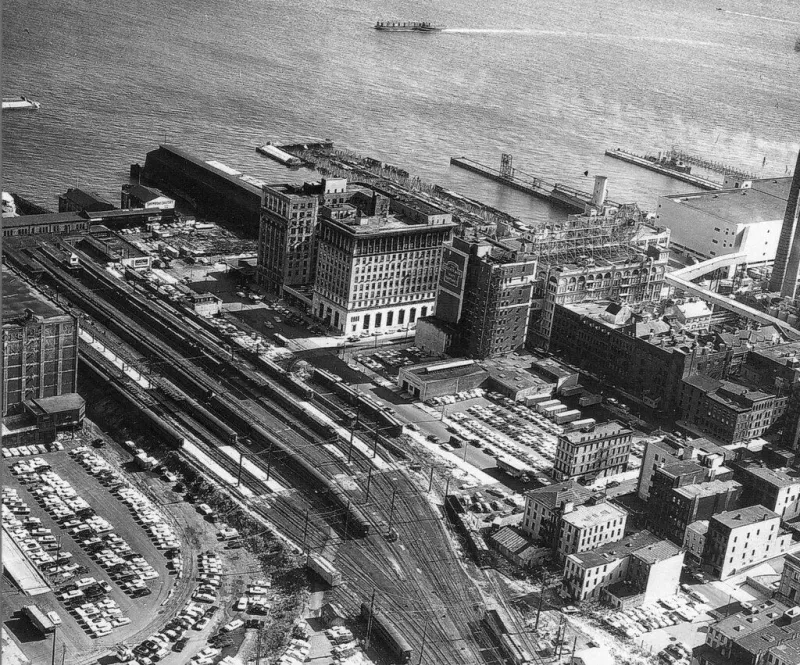
Jersey City's early industrial promise rested substantially on its waterfront. The Central Railroad of New Jersey and the Pennsylvania Railroad had each established major terminal facilities along the Hudson River shoreline, transforming the city into one of the busiest freight-handling centers on the Eastern Seaboard. Civic leaders and investors in the 1880s reasonably concluded that this transportation infrastructure would attract manufacturers eager to move raw materials in and finished goods out with maximum efficiency.
What those optimists underestimated was Paterson's countermove. Throughout the 1880s and into the 1890s, Paterson's textile industry — particularly its silk mills — attracted sustained investment from both domestic entrepreneurs and European immigrant craftsmen who brought specialized technical knowledge with them from Lyon, France, and the Macclesfield district of England. Mill owners in Paterson lobbied aggressively for railroad spur lines connecting their factories to regional distribution networks, gradually neutralizing Jersey City's geographic advantage.
Jersey City, for its part, made a fateful choice. Rather than competing directly for textile and heavy manufacturing, city officials and the powerful railroad interests that effectively governed much of the waterfront doubled down on the port and rail terminal economy. Land that might have been zoned and developed for factory use was instead committed to rail yards, ferry slips, and warehousing operations. The short-term revenue was reliable; the long-term consequences were profound.
Political Calculations and Missed Opportunities
No honest accounting of this period can ignore the role of machine politics. The Tammany-aligned Democratic organization that dominated Jersey City's government through much of this era was primarily concerned with patronage, public contracts, and maintaining the loyalty of an overwhelmingly working-class immigrant electorate. Large-scale manufacturing attracted labor organizers and posed risks to the carefully managed political equilibrium that ward bosses depended upon.
Paterson's political culture, while hardly immune to corruption, was more willing to accommodate the demands of industrial capital. When mill owners sought tax abatements, infrastructure improvements, or favorable zoning arrangements, they generally found a receptive audience in Paterson's city government. Jersey City's political leadership, by contrast, often viewed industrial interests with a mixture of suspicion and indifference — unless those interests were directly tied to the railroad companies whose freight operations underpinned the city's tax base.
This divergence in political orientation had measurable consequences. Between 1880 and 1910, Paterson's manufacturing workforce grew at roughly twice the rate of Jersey City's, and the range of industries operating in Paterson expanded well beyond silk to include locomotive manufacturing, firearms production, and textile machinery. Jersey City's industrial base, while substantial, remained narrower and more dependent on the fortunes of the transportation sector.
The Entrepreneurial Dimension
Beyond politics and infrastructure, individual entrepreneurial decisions left lasting marks on both cities' trajectories. Paterson benefited enormously from the clustering effect that economists now recognize as a driver of industrial development. Once a critical mass of silk manufacturers had established operations there, the city attracted specialized suppliers, skilled workers, and ancillary businesses that made it progressively more attractive to the next wave of investors. This self-reinforcing dynamic was difficult for Jersey City to disrupt, even had its leaders been inclined to try.
Jersey City did produce notable industrial enterprises during this period. The Colgate-Palmolive factory that operated for decades along the waterfront, the Dixon Crucible Company's pencil manufacturing operations in the Paulus Hook area, and various chemical and paint manufacturers scattered across the city's industrial districts all testified to genuine manufacturing activity. Yet these enterprises never coalesced into the kind of dominant industrial identity that Paterson achieved. They remained individual ventures rather than the nucleus of a self-sustaining industrial ecosystem.
A Pivot That Shaped the Modern City
By the first decade of the twentieth century, the broad outlines of each city's future had been sketched. Paterson would continue its manufacturing trajectory, experiencing both the prosperity and the labor strife — most famously the Silk Strike of 1913 — that accompanied industrial dominance. Jersey City would deepen its commitment to the transportation and commercial economy, a direction that would eventually position it to benefit from the financial services expansion of the late twentieth century.
That pivot was not without its costs. The working-class communities that had hoped Jersey City would offer factory employment comparable to what Paterson provided were often disappointed. Waves of Italian, Polish, and Eastern European Jewish immigrants who settled in the city's densely packed neighborhoods found work primarily in the service trades, construction, and the railroad and ferry operations — employment that was steady but rarely offered the upward mobility that skilled factory work could provide.
What the Archive Tells Us
The records preserved in the New Jersey State Archives, the Jersey City Free Public Library's New Jersey Room, and the collections of the Jersey City Landmarks Conservancy paint a nuanced picture of this competitive period. Municipal reports from the 1890s reveal genuine ambition for industrial development alongside a persistent reluctance to make the land-use and fiscal commitments that such development required. Business directories from the same era document the gradual thinning of manufacturing enterprises relative to commercial and transportation-related firms.
This archival evidence suggests that Jersey City's industrial fate was not simply imposed from outside but was, at least in part, chosen — shaped by the accumulated preferences of political leaders, investors, and residents who found the transportation and commercial economy more congenial to their interests and circumstances.
The city that emerged from this period was neither a failure nor a consolation prize. It was a distinctive urban form, shaped by particular choices made at particular moments, and its subsequent reinvention as a financial services center and residential alternative to Manhattan was made possible precisely because those earlier decisions had built the infrastructure of connectivity rather than the infrastructure of production. Understanding that history is essential to understanding the city Jersey City has become.