Erased Accounts: The Destruction of Jersey City's Immigrant Commercial Records and the Economic History We Can No Longer Read
Somewhere in the back room of a Polish delicatessen on Newark Avenue, sometime in the early 1960s, a proprietor named Stanisław Wojcik — according to his granddaughter, Rosa Kaminski — burned three decades of account ledgers in a backyard oil drum. He was not being careless. He was making space. The building had been sold. The neighborhood was changing. Paper, he reasoned, was not the same thing as memory.
He was wrong, of course. But he was also not unusual. Across Jersey City's long history as one of the most ethnically diverse urban centers on the Eastern Seaboard, the commercial records of immigrant-owned businesses — the account books, supplier invoices, customer credit lists, and handwritten correspondence that documented the daily mechanics of ethnic economic life — disappeared with a thoroughness that now borders on the catastrophic. What survives is fragmentary, scattered, and often accessible only through the determined labor of descendants who have spent years assembling partial pictures from incomplete evidence.
The consequences for historical understanding are severe. Jersey City's immigrant business communities were not marginal footnotes to the city's economic story. They were, in many respects, the story itself.
The Scale of What Is Gone
Historians who have attempted to reconstruct the commercial landscape of Jersey City's immigrant neighborhoods — the Syrian dry-goods merchants of the Lafayette district, the Italian wholesale grocers of the Sixth Ward, the Jewish garment suppliers clustered near the waterfront, the Cuban cigar manufacturers operating in the 1890s — consistently encounter the same obstacle: the primary source record is almost entirely absent.
City directories and census records can establish that a business existed. Newspaper advertisements can suggest its general character. But the internal documents that would reveal how these enterprises actually functioned — who their suppliers were, how they extended credit to newly arrived immigrants, how they navigated economic downturns, how they trained the next generation — are largely gone.
"What we have is a silhouette," said Dr. Margaret Osei, a historian of urban commerce who has conducted research at the New Jersey State Archives and the Jersey City Free Public Library's New Jersey Room. "We can see the outline of these businesses. We cannot see inside them. And the inside is where the real history lives."
The reasons for the disappearance are multiple and overlapping. Urban renewal projects of the postwar decades displaced entire commercial districts, often with little notice and less time for proprietors to preserve records. Fires — common in the densely built commercial blocks of the Journal Square and downtown areas — destroyed whole inventories of paper. Families who emigrated, or whose businesses closed, frequently saw no reason to transport bulky commercial records to new addresses. And the institutions that might have collected such materials — libraries, historical societies, universities — rarely sought them out, having long prioritized the records of native-born, English-speaking commercial establishments.
What the Fragments Tell Us
The surviving record, however sparse, is instructive. The New Jersey Room at the Jersey City Free Public Library holds a small but significant collection of materials related to the city's Syrian and Lebanese merchant community, including several decades of correspondence between a dry-goods importer and his suppliers in New York and Boston. Read carefully, these letters reveal a credit network of considerable sophistication — one in which newly arrived immigrants could establish commercial relationships based on community vouching rather than formal banking credentials.
"These men were operating outside the mainstream financial system because the mainstream financial system had no interest in them," said Kaminski, whose own research into her grandfather's delicatessen has led her to study the broader patterns of immigrant commercial organization. "They built parallel structures. And those structures worked. But because the records are gone, nobody knows how they worked."
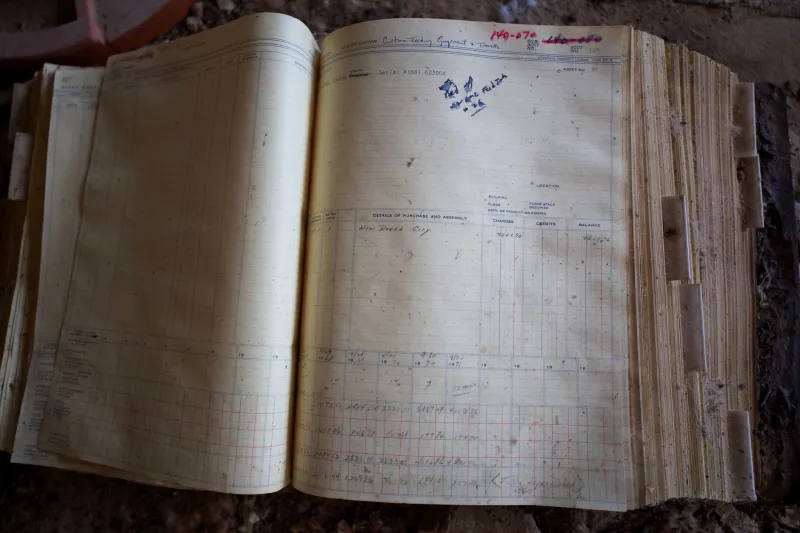
Similar patterns emerge from the few surviving account books of Italian-owned grocery concerns in the Greenville neighborhood. Entries recorded in a mixture of Italian and English show customers purchasing goods on credit, with repayment schedules negotiated informally and recorded in the proprietor's own shorthand. The ledgers function simultaneously as financial documents and as social maps — recording the names, addresses, and apparent economic circumstances of hundreds of neighborhood residents who would otherwise leave almost no trace in the historical archive.
These documents are irreplaceable. And they are exceptions.
The Institutional Failures Behind the Loss
The disappearance of immigrant business records was not simply the result of individual decisions to discard paper. It reflected a systematic failure by archival institutions to recognize the historical value of non-English-language commercial documents.
For much of the twentieth century, the collecting priorities of New Jersey's major historical repositories focused on the records of prominent Anglo-American families, established corporations, and governmental bodies. The account book of a Syrian dry-goods merchant or a Polish butcher did not fit the prevailing definition of historically significant material. By the time that definition began to broaden — influenced by the social history movements of the 1970s and 1980s — much of the material was already gone.
"There was a window," said Dr. Osei. "And the window closed before the institutions were ready to act."
Some researchers argue that the loss was compounded by the nature of the businesses themselves. Many immigrant enterprises operated on the margins of formal record-keeping, maintaining accounts in ways that reflected the practices of their countries of origin rather than American commercial conventions. Documents written in Arabic, Polish, Yiddish, Italian, or Portuguese were not merely overlooked by archives — they were actively unintelligible to the archivists who might otherwise have recognized their value.
What Descendants Are Doing Now
In the absence of institutional preservation, recovery efforts have fallen largely to families. Across Jersey City, descendants of immigrant business owners are engaged in quiet, often solitary work — interviewing elderly relatives, digitizing photographs, translating letters, and piecing together commercial histories from whatever materials chance has allowed to survive.
Kaminski has spent four years reconstructing the history of her grandfather's delicatessen, working from a handful of photographs, two surviving invoices, and the memories of her mother and two surviving aunts. The result is a detailed but necessarily incomplete portrait of a business that served the Polish community of the Journal Square area for more than thirty years.
"I know what he sold. I know some of his suppliers. I know that he gave credit to families who couldn't pay immediately," she said. "What I don't know — what I can never know now — is the full scope of what he built. The ledgers are ash."
Other families have had better luck. A collection of records from a Lebanese-owned textile business, donated to a Rutgers University archive in the 1990s by a descendant clearing out an estate, has become one of the most cited sources for historians studying early twentieth-century Arab American commerce in New Jersey. The donation was nearly accidental — the descendant had intended to discard the materials before a family friend suggested their potential historical significance.
The Argument for Urgent Action
The lesson drawn by historians and archivists who study this gap is straightforward: what has not yet been lost can still be saved, but only if the effort begins immediately.
The generation of immigrants who established Jersey City's ethnic business communities is gone. But their children and grandchildren — many of them now in their seventies and eighties — retain memories, photographs, and occasional documents that constitute the last surviving evidence of commercial worlds the archive has otherwise failed to capture. When those individuals die, the opportunity for recovery dies with them.
Several local organizations have begun modest oral history and document collection initiatives aimed at filling this gap, but the resources available remain limited relative to the scale of the need. What is required, historians argue, is a sustained, well-funded, and institutionally committed effort to seek out and preserve whatever commercial records remain in private hands — accompanied by the translation capacity and the archival expertise necessary to make those records genuinely accessible to researchers.
The ledgers that disappeared cannot be recovered. But the ones that survive — in attics, in storage units, in the bottom drawers of old desks — still can be. The question is whether the institutions responsible for preserving Jersey City's history will act before that window, too, closes.