The Terminal Deserved Better Than Nostalgia: Rethinking the Central Railroad's Long Goodbye
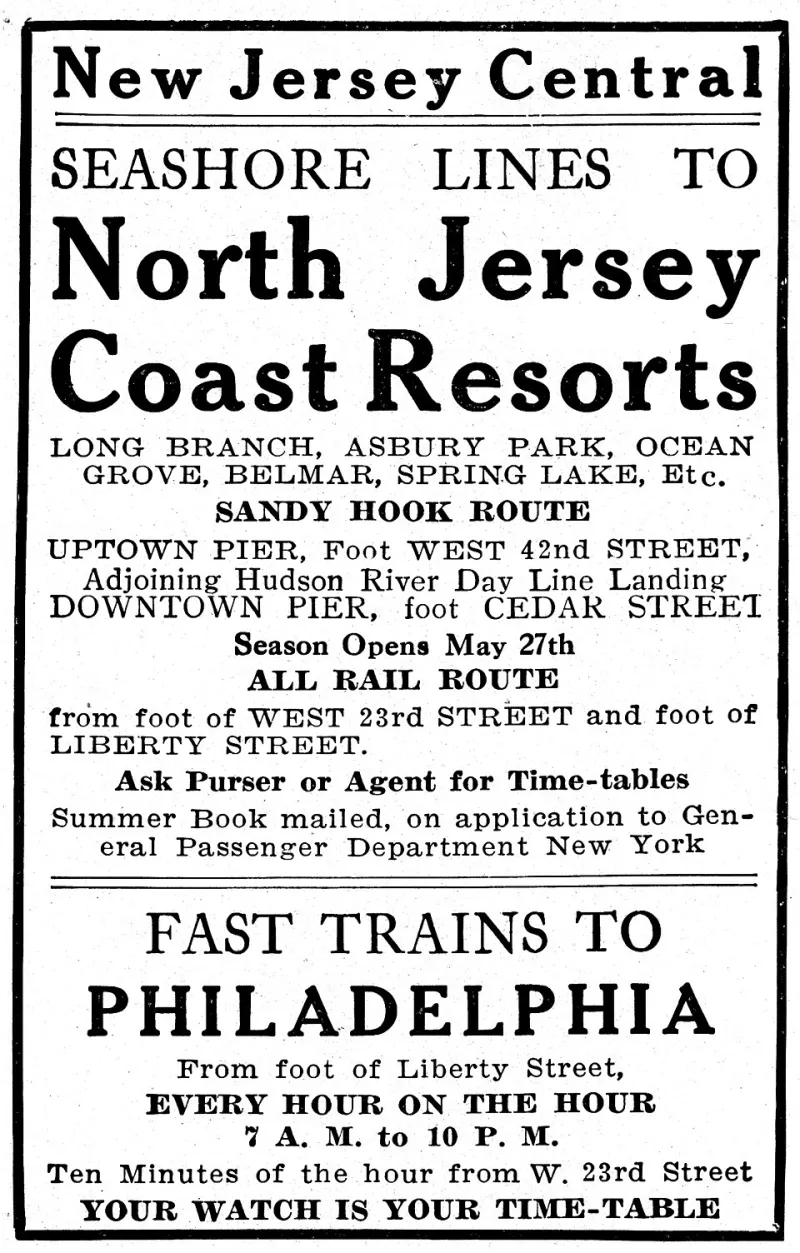
Photo: Jew Jersey Central Railroad, Public domain, via Wikimedia Commons
Two Stories, Both Incomplete
Ask about the Central Railroad of New Jersey Terminal and you will generally receive one of two narratives. The first is romantic: the great shed teeming with immigrants funneling toward ferries, commuters in fedoras, a cathedral of steam at the height of the railroad age. The second is redemptive: the derelict hulk rescued by preservationists in the 1970s and 1980s and reborn as the gateway to Liberty State Park.
Both are true. Neither, on its own, is honest. The terminal's real history — the part that matters for understanding Jersey City — lives in the long, unglamorous middle between those two stories, and in what the restored building chooses not to say.
The Machine at Its Peak
In its heyday, the terminal was less a building than a system. Trains from the anthracite coal country and the Lehigh Valley deposited commuters and freight onto the Jersey City waterfront, where ferries carried them across to Manhattan's financial district. For tens of thousands of workers, the terminal was simply the daily mechanism by which a job in New York became compatible with a house in Jersey City. The building's grandeur was real, but it was grandeur in service of repetition — the same crowd, the same clock, the same ferry, six days a week.
The terminal also processed arrivals of a different kind. For immigrants moving through the region's ports and stations, the Jersey City waterfront was often their first measurable contact with the American economy — ticket agents, employment touts, baggage porters, boarding-house runners. The terminal did not merely move people; it sorted them.
The Long Decay
What followed the automobile and the tunnel was not a collapse but a fade. Service contracted decade by decade; the last trains and ferries emptied out by the late 1960s. And here the conventional story goes quiet, because the decay years are the least flattering part of the record. The terminal sat open to weather, stripped of copper and glass, while the waterfront around it became a corridor of railyards and brownfields that the city had, in effect, written off.
The preservation campaign that eventually saved the building was genuinely heroic — and genuinely contested. Detractors asked, not unreasonably, why scarce public money should preserve a monument to a railroad corporation while living neighborhoods nearby lacked basic services. That question was never fully answered. It was simply overtaken by the waterfront boom that followed.
Saved or Sanitized?
Today the restored terminal is a handsome civic stage — events, ferries, tourists bound for the Statue of Liberty. It is worth asking what got restored and what got edited out. The building's exhibits celebrate the immigrant journey; they are quieter about the railroad's labor disputes, the pollution the terminal era bequeathed to the waterfront, and the Black and immigrant workers whose maintenance of the system rarely appears in the commemorative framing.
Preservation, at its best, keeps a building arguing with itself. At its worst, it settles the argument in favor of the most comfortable version. The CNJ Terminal, for all its beauty, currently leans comfortable.
The most misunderstood chapter of Jersey City's story is not the terminal's rise or even its fall. It is the assumption that restoring the bricks settled the account. A building that moved millions of lives through its gates owes those lives a more complicated memory than a plaque can hold — and the city that grew up in its shadow is still the right place to write it.