Blueprints Beneath the Bay: The Unsung Engineers Who Designed Jersey City's Transit Nervous System
The morning rush hour at Journal Square feels, to most commuters, like an unremarkable fact of urban life—turnstiles clicking, trains arriving, crowds dispersing into the streets above. What that ordinary experience conceals is something considerably more remarkable: a subterranean and aquatic infrastructure assembled across several decades by engineers whose names have almost entirely disappeared from public memory. Jersey City's transit network did not emerge organically. It was calculated, argued over, revised, and ultimately built by technically gifted professionals whose contributions have been absorbed into the anonymous machinery of the city itself.
To understand what they accomplished, it is necessary to appreciate what they were working against.
A City at the Edge of Everything
Jersey City occupies a peculiar geographic position. Bounded on the east by the Hudson River and interrupted internally by tidal inlets, meadowlands, and dense industrial development, it presented nineteenth- and early twentieth-century transit planners with challenges that had few precedents in American engineering. The city was not simply a destination—it was, for decades, the primary gateway through which goods and people entered the eastern seaboard. The Pennsylvania Railroad's exchange point at Communipaw Terminal, the ferry operations that predated tunnel construction, and the freight rail corridors threading south toward Bayonne all converged on a relatively compact urban geography already burdened with industry, immigration, and competing municipal interests.
The engineers assigned to rationalize this complexity operated largely outside public view. Unlike architects, whose finished buildings invite inspection and attribution, transit engineers produced work that was either buried underground or disguised behind the functional anonymity of platforms, signal houses, and switching yards. Their professional legacy exists primarily in archival form—in engineering journals, municipal contract records, and the personal correspondence that descendants have occasionally preserved.
The Tunnel Builders
The Hudson River tunnels that would eventually become the PATH system represent perhaps the most technically audacious chapter in Jersey City's infrastructure history. The project's origins stretched back to the 1870s, when entrepreneur DeWitt Clinton Haskin began a first attempt at boring beneath the river using compressed air—a method that resulted in catastrophic flooding and the deaths of several workers. The project stalled for years before being revived under the financial backing of William Gibbs McAdoo and the technical supervision of engineers whose names rarely surface in popular accounts of the line's construction.
Chief among the challenges was the behavior of the riverbed itself. The silt and clay beneath the Hudson were unpredictable, prone to sudden pressure shifts that could compromise the pneumatic caissons used to advance the tunnel face. Engineers developed site-specific solutions—modified grouting techniques, adjusted air-pressure protocols, reinforced cast-iron lining segments—that drew on European precedents but required significant adaptation to local geological conditions. Correspondence preserved in the collections of the New Jersey State Archives reveals sustained technical debate among project engineers about acceptable risk thresholds, debates that had direct consequences for the safety of construction workers and the long-term structural integrity of the tubes.
The men who resolved those debates are identified in the archival record primarily through their professional titles and project roles rather than through any subsequent public recognition. Their work, completed in stages between 1908 and 1910, created a transit artery that would carry an estimated 100 million passengers annually by the mid-twentieth century.
Ferry Coordination and the Problem of Scale
Before the tunnels opened, the Hudson River ferries represented Jersey City's primary connective tissue with Manhattan. Managing that system required a different order of engineering intelligence—less geological and more organizational, concerned with the choreography of vessels, docking infrastructure, and passenger flow at a scale that contemporary observers found genuinely bewildering.
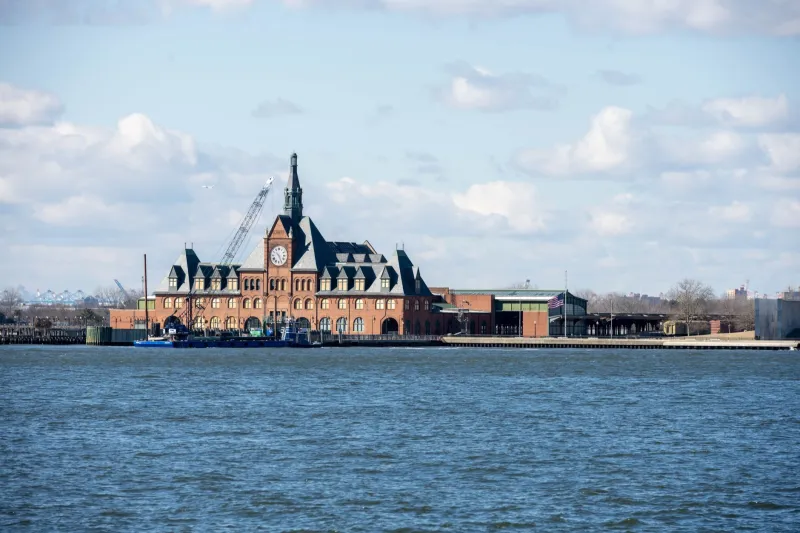
The Central Railroad of New Jersey's ferry terminal at Liberty State Park's predecessor site, along with the Communipaw operations of the Pennsylvania Railroad, processed thousands of passengers daily during peak periods. The engineers responsible for terminal layout and vessel scheduling developed what were, in effect, early models of what we would now call systems engineering—coordinating physical infrastructure, human behavior, and mechanical timetables into a functioning whole. Accounts from the period, preserved in railroad company records and in the pages of trade publications such as Railway Age, describe the methodical refinement of boarding procedures, gangway configurations, and waiting-room capacities that made mass transit across the river practically feasible.
These planners understood something that later generations of transit advocates would have to rediscover: that the quality of a transit system is determined not only by its primary vehicles but by the experience of transfer. The ferry-to-rail interface at Jersey City's major terminals was, by the standards of its era, a sophisticated piece of operational design.
Decisions That Shaped Neighborhoods
The transit infrastructure these engineers designed was never simply neutral. The placement of a station, the routing of a rail line, the location of a ferry terminal—each of these decisions carried profound implications for which neighborhoods would develop, which would stagnate, and which would be bisected or isolated by the infrastructure itself.
The elevated rail structures that once ran through portions of Jersey City created shadow corridors that depressed property values and concentrated poverty in adjacent blocks. The routing decisions that determined where those structures were built reflected a mixture of engineering logic, land acquisition economics, and political negotiation that frequently disadvantaged communities with limited political representation. Descendants of families who lived beneath the elevated lines recall, in oral histories collected by local preservation organizations, the persistent noise, the diminished light, and the sense of being on the wrong side of a decision made elsewhere.
At the same time, the extension of rail and ferry access into previously underserved neighborhoods enabled waves of immigrant and working-class families to access employment across the region. The transit network was, in this sense, both an instrument of constraint and a mechanism of opportunity—its effects depending heavily on where a family happened to live relative to the infrastructure map.
Recovering the Record
The work of recovering these engineers from historical obscurity is painstaking and incomplete. Municipal engineering departments did not always maintain systematic personnel records, and the firms contracted for major infrastructure projects frequently dissolved or merged, dispersing their archives. What survives is fragmentary: a set of technical drawings here, a company newsletter there, the occasional obituary in a professional journal that offers a paragraph of biographical context alongside a list of completed projects.
Descendants of several engineers who worked on Jersey City's transit infrastructure have, in recent years, contributed materials to local historical collections—including personal photographs, correspondence, and in one case a set of hand-annotated construction drawings that document site-specific problem-solving in real time. These materials offer rare glimpses into the daily intellectual labor of infrastructure building: the crossed-out calculations, the marginal notes, the revised specifications that record a mind working through an unprecedented problem.
The Jersey City Free Public Library's New Jersey Room holds portions of this accumulated record, alongside municipal contract documents and engineering department correspondence that have received relatively little scholarly attention. For researchers willing to work through the archival material, the outlines of a significant professional history begin to emerge.
What Persists
The infrastructure these engineers produced has outlasted nearly every other artifact of their professional lives. The Hudson tubes still carry commuters. The rail corridors they surveyed still determine the geometry of neighborhoods. The terminal sites they designed, even where the original structures have been demolished, still anchor the transit geography of the waterfront.
There is something worth pausing over in that persistence. The city's physical form is, in a meaningful sense, a record of decisions made by people whose names we have largely ceased to speak. Recovering those names, and the technical reasoning behind the choices they represent, is not merely an act of historical justice—though it is that. It is also a way of understanding, with greater precision, why Jersey City looks and functions the way it does, and what it would mean to make different decisions going forward.